Build the Brain. Change the Learning Trajectory.
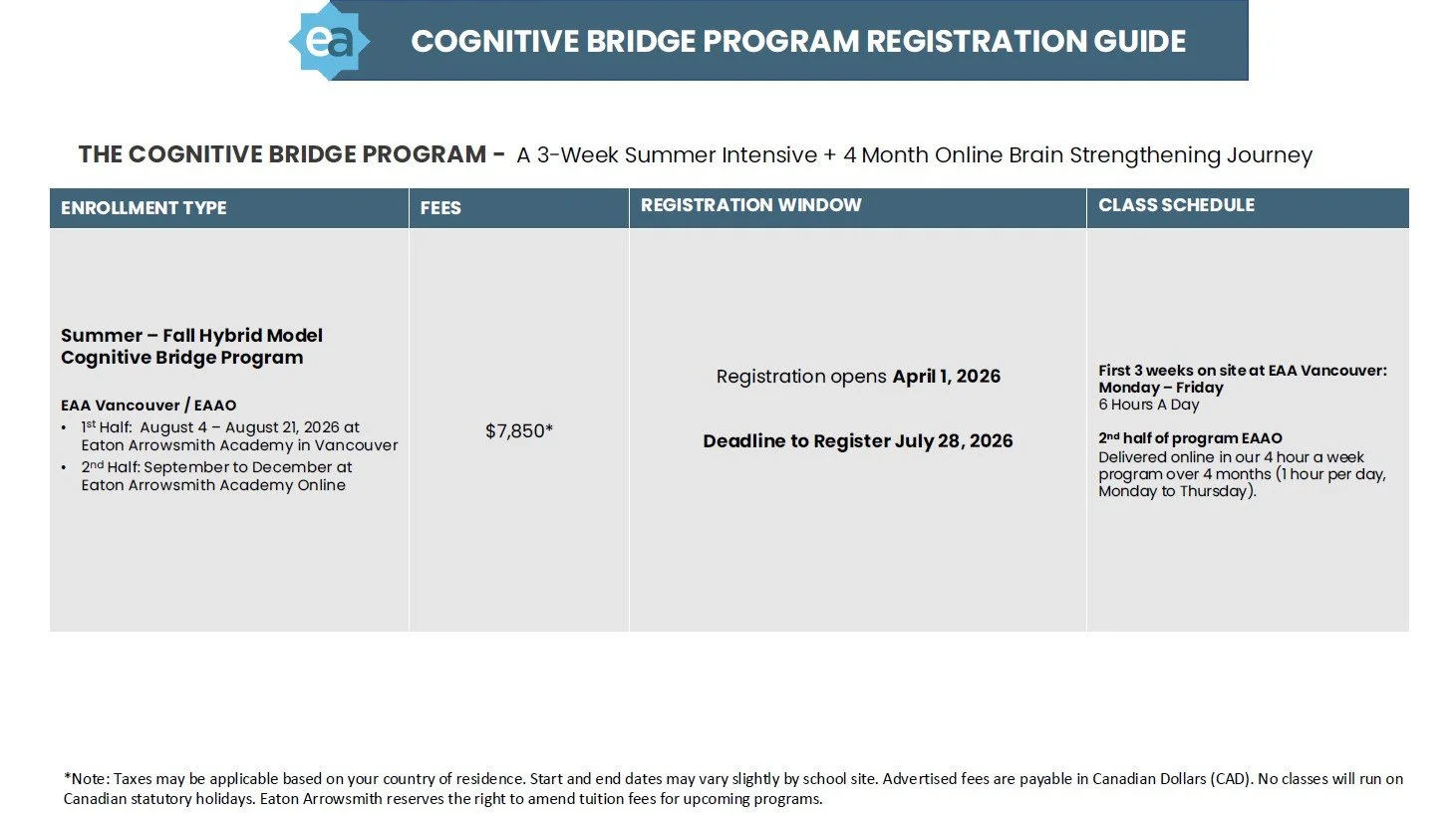
A 3-week summer intensive followed by a 4-month guided online program designed to strengthen the cognitive capacities that underlie learning.
For more than 40 years, the brain-changing methods and exercises we utilize have transformed thousands of lives around the world.
The results can help your student:
Boost their capacity to focus
Process information quicker
Understand more concepts and ideas faster
The Problem
Your child may be:
Bright but struggling
Working hard with limited results
Losing confidence in their abilities
Most programs teach students how to cope.
We focus on why learning is difficult and how to change it.

The Solution
The Cognitive Bridge Program
A structured pathway that combines:
Intensive in-person cognitive training
Sustained online strengthening
This is not tutoring.
This is cognitive capacity development.

How It Works
Step 1: Summer Intensive (3 Weeks)
Jumpstart progress through immersive, targeted cognitive exercises.
Step 2: Online Continuation (4 Months)
Reinforce and deepen gains through consistent, guided sessions.
Step 3: Lasting Change
Students build stronger neural pathways that support:
Learning
Thinking
Academic success
Why the “Bridge” Matters
Short programs often create temporary gains.
Long term programs require momentum to get started.
The Cognitive Bridge Program does both:
Ignites change quickly
Builds it into lasting transformation
Outcomes
Families commonly report:
Increased focus and attention
Improved reading and comprehension
Greater independence
Renewed confidence
Who This Is For
Students who:
Struggle with learning despite effort
Have diagnosed or suspected learning difficulties
Need stronger cognitive foundations, not just support strategies
“Why Families Choose This Program”
Structured, research-informed approach
Personalized cognitive training
Clear pathway from short-term effort to long-term gain
Trusted by families worldwide
Start the Journey This Summer!
Spaces are limited to ensure individualized attention
Join our new Cognitive Bridge Program!
The Symbol Relations cognitive function is addressed in the Cognitive Intensive Programs, and is available as an option in the 4 Hours A Week Program as well. Learn more about this foundational Arrowsmith exercise here: What Is Symbol Relations?
"Our findings indicate that participation in a brief, yet concentrated regimen of this cognitive training exercise [Symbol Relations for six weeks] elicits positive changes in these well-being measures. Symbol Relations training is associated with widespread improvements in social and emotional functions."
Negin Motamed Yeganeh et al, University of British Columbia, Examining the Impact of Intensive Cognitive Training on the Social Emotional Well-being of School-Age Children 2022.
"Participants showed significant improvements in the broad abilities of Comprehension-Knowledge, Fluid Reasoning, Cognitive Process Speed, Long-Term Retrieval, and the narrow abilities of Perceptual Speed, Cognitive Efficiency, and Extended Cognitive Efficiency. These results provide evidence of possible near transfer for the effects of Symbol Relations training [six week program]."
Negin Motamed Yeganeh, et al, Symbol relations training improves cognitive functioning in students with neurodevelopmental disorders, Applied Neuropsychology: Child, 2022, Vol 11, No. 4, 789-796
"Participants in the six-week Cognitive Intensive Program (CIP) improved their performance in the Symbol Relations Task that were correlated with changes in resting-state brain connectivity. The most notable change was increased connectivity between the Default Mode...and the Salience Networks...and the Frontoparietal Network..."
Jagger-Rickels et al, Exploring the Relationship Between Improvement in an Intensive Learning Intervention and Changes in Resting-state Functional Connectivity (2018)
Frequently Asked Questions
Individuals who struggle to understand what they read, take longer to make connections between concepts, find problem solving and math challenging, are perplexed by jokes or sarcasm, think in a rigid fashion and always feel a few steps behind in understanding situations.
The Cognitive Intensive programs are accelerated, and therefore, most benefits students who can engage in material with a great deal of independence. There are also important prerequisite skills that will greatly aid in a student’s success and progress.
Counting Skills:
Many of the exercises are based on concepts found in a 2 handed analog clock. The following counting skills are important in ensuring the best possible start to the program.
- Counting from 1-60
- Counting from 60-1 (reverse)
- Counting from 5-60 by 5’s
- Counting 12-60 by 12’s
Participants should have a basic understanding of a 2 handed analog clock. Counting skills may require daily practice leading up to the start of the program.
Numeric Keypad Touch-Typing Skills:
- Students will need to know how to type numbers on the numeric keypad. This is the keypad on the right-hand side of the keyboard, not the numbers along the top.
- Should your computer not have a numeric keypad, one can be purchased online or through most computer retailers – there are many to choose from – and they easily plug into the side of the computer.
- Participants will be using the numeric keypad to enter numbers quickly and accurately, using multiple fingers.
- To improve proficiency in touch typing, daily practice is recommended. Some websites offer free tying programs, be sure to look for websites or apps that have numeric keypad options.
Examples
Typing StudyTyping
VIRTUAL
Through the Microsoft Teams online platform our students join our virtual classroom led by certified Arrowsmith teachers. This program is designed so that students will be part of a virtual classroom, and will have the opportunity to see and connect with others in the class during the day.
IN-PERSON
In-person programs run like a regular school classroom schedule, with learning blocks and breaks throughout the day. Class sizes are kept small at 10 per teacher for individualized teaching opportunities.
For the online program:
A desktop computer or laptop with:
- Minimum screen size of 15". Students report the best experience with a standard desktop monitor (19 - 21”).
- A keyboard with a numeric keypad – usually found on the right of the keyboard (The numbers along the top of a keyboard are not sufficient.). If using a laptop, you will usually need to plug in an external keyboard.
- An external mouse with two clickable buttons – left and right (Mousepads or laptop trackpads are NOT sufficient).
- Reliable high-speed internet
- Google Chrome browser
- Microsoft Teams app (Free to download)
- Chromebooks, Ipads and Tablets are not compatible
Reflections
A few reflections from a parent and adult student perspective.
AS FEATURED IN:


“He is able to read a book much more smoothly. He does not see so many words at once on a page. He also really enjoys reading out loud now.”
- Parent of a summer Cognitive Intensive Program Student

“
Concentration has definitely much improved, she’s a little less rigid, and is able to regulate her emotions quicker.
- Parent of 2019 Summer Cognitive Intensive Program Student
“
Can’t stress enough that we can see marked improvement in him from his time with you this summer....especially in his reading!
- John & Fabienne Wade, EA parents, Redmond, Washington, USA
“
I have noticed my child is more emotionally aware. I can see she is more confident and knows the consequences of her actions.
- Parent of 2019 Summer Cognitive Intensive Program Student
“
2018 was the second time we travelled from New Zealand to Canada for Tallulah to spend 6 weeks full time at Eaton Arrowsmith. There is a significant improvement in levels of engagement and concentration. She has always been independent but now she is wanting to achieve things entirely on her own. She is so much happier.
- Raquel Smith, EA parent, Vancouver, BC, Canada
DID YOU KNOW?
A student with learning disabilities can lose $700,000+ in lifelong earnings if you don’t act to improve their brain’s capacity.
In 2018, Statistics Canada published an article entitled, “Canadians with disabilities: A demographic, employment and income profile, 2017.” The article noted, “Among youth with disabilities who were neither in school nor employed, 87% had a mental health-related disability, a learning disability, or both.” Finally, “Since those with mental health-related and/or learning disabilities accounted for 77% of youth with disabilities, this suggests they are disproportionately affected when it comes to being neither in school nor employed.”
Enrolling at Eaton Arrowsmith will forever alter the course of a student’s life and career.
40+
Number of years the Arrowsmith Program has been changing tens of thousands of lives with proven and well-studied results.
1,500+
Number of students that have successfully transitioned to mainstream curriculum, universities and careers.
4,000+
Number of educational professionals across the globe who subscribe to Eaton Arrowsmith as a resource for their work with families.
HOW IT WORKS
Arrowsmith Program

The Arrowsmith Program exercises are designed to strengthen weak neuropathways and improve your child’s learning capacities.
Why is Learning a Struggle
When kids, youth, and adults are struggling with activities like reading, mathematics, or problem-solving, the areas or pathways in their brain that process this information are either weak or overactive. For some, this leads to mild learning difficulties while, for others, more severe learning disabilities, like dyslexia or dyscalculia.

Do these struggles in learning and life look familiar?
Swipe to see how we can help.
→

Math or Science
Help to better grasp numbers and formulas.

Reading Comprehension
Help to better understand what is read.

Connecting Concepts
Help to better understand ideas and concepts.

Thinking “Big Picture”
Help to understand what’s most important.

Executive Functioning
Help to better plan and problem solve.

Jokes and Sarcasm
Help to better understand humor.